Van Vlaenderen
This site is a genealogical research project dedicated to the surname Van Vlaenderen — a name borne by families who lived for centuries in the villages of the Meetjesland in East Flanders: Ursel, Bassevelde, Boekhoute, Kaprijke, Evergem, and their neighbours.
If you arrived here looking for information about the Flanders region itself, you are warmly welcome — and we hope the history woven through this research is of interest to you. This project is about one family name, not the region as a whole.
The conventional reading of the surname is toponymic: Van Vlaenderen simply means 'from Flanders,' a label that could have attached to any family that migrated from the broader region into a more local community. Many Flemish surnames share this pattern, and for most bearers of the name, this explanation may well be the complete story.
The name is toponymic in form — built from a place-name, exactly as the dictionaries classify it, and that much is settled. The open question is what the name pointed to for the families who first carried it: a place they came from, or the comital house they came from. The documentary record raises questions the place-of-origin reading does not easily answer — and this project exists to investigate them.
When the earliest traceable Van Vlaenderen lines across the Meetjesland parishes are mapped together, why does the name cluster into a small number of founding families rather than scattering randomly across the region, as a simple place-of-origin label would? One possible explanation is that the surname was originally an office or household identifier — servants and officials of the Count of Flanders carried administrative titles such as "messenger of my lord of Flanders" in their working lives, and in later generations those titles could harden into inherited family names. Under this hypothesis, different founding families emerged independently, each descending from a different comital office-holder, and the clusters would share no recent common ancestor.
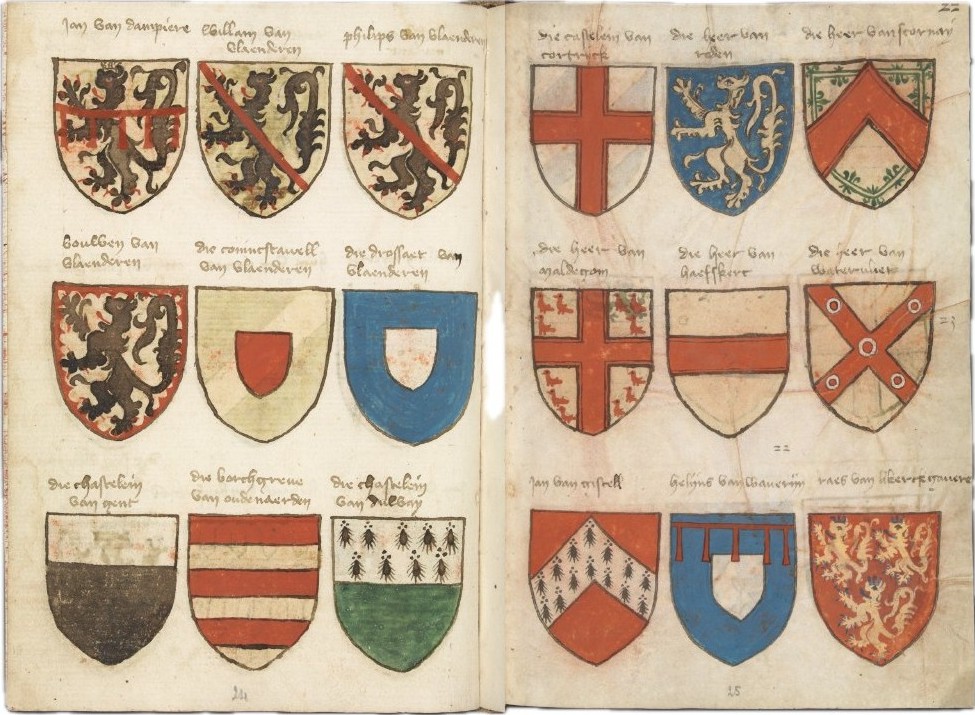
The Van Vlaenderen surname concentrates inside the historic County of Flanders itself, not at its edges — the oldest recorded bearers in the comital cities of Bruges, Ypres, and Ghent, the densest later clusters in the Meetjesland and around Cassel — where a "from Flanders" label would have been geographically meaningless to neighbours. This is the paradox at the heart of the research: why is a toponymic surname densest precisely where the toponym would have carried no information? One possible answer lies in the family of the Counts themselves. Louis II, the last Count of Flanders from the House of Dampierre, recognised at least eighteen illegitimate children before his death in 1384, and at least five of his acknowledged natural sons founded documented surname-bearing lines, each anchored to a lordship he had granted them. Under this hypothesis, the Van Vlaenderen surname in the Meetjesland, French Flanders, and Brabant parish registers traces back to one of these comital bastard lines — carried forward not as a description of geographic origin, but as a guarded, inherited identity marking descent from the Counts themselves at the point when their title itself was extinguished. The documented bastard lines and their sources are set out in full in the research dossiers — the eighteen-child count, explicitly a minimum, per P. de Lichtervelde, "Les Bâtards de Louis de Male" (1935); the five lines per Vredius's 1643 Genealogia, Buylaert's Repertorium van de Vlaamse adel (2011), and the fifteenth-century chronicle roster printed in de Smet's Recueil des chroniques de Flandre.
These two hypotheses are not mutually exclusive — an office-holder founder and a bastard-line founder could both have seeded Van Vlaenderen families — but they make testably different predictions about how the modern clusters are related to one another, and the Y-DNA project is designed in part to distinguish between them. The archival and genetic evidence is inconclusive at present, and the project remains collaborative and open.
This project is collaborative by design. If you carry the name Van Vlaenderen — in any historical spelling — or if you descend from a Van Vlaenderen woman whose line continued under a different name, your family records and DNA results may hold a piece of the answer. We invite you to explore what has been gathered here, compare it against your own research, and get in touch.
No claim is made here that any living person descends from the Counts of Flanders. We are researchers, not storytellers. The evidence will go where it goes.