Eight Centuries of the Name
Nearly everyone on this page carried the name you carry. The few who did not carried something rarer: the comital blood, or the title, that the name may descend from.
Across eight centuries the bearers were an admiral and a prioress, lawyers and millers, an emigrant who crossed an ocean and a game warden shot for carrying messages across a border. The name's beginning is well documented: in the house of the Lions of Flanders, the dynasty of Robrecht van Bethune, the last count of that old line, Louis II de Male, acknowledged the natural children who turned comital blood into a family name. What the records do not yet show is whether the name as it is carried today descends from that origin, or whether that was even its only source. Which of these bearers are truly family is the question this project, and its DNA work, was built to answer.
Explore the five documented lines →
The count's children
Victor van Vlaenderen († 1431) — The admiral.
Acknowledged son of Louis II de Male, Count of Flanders. Captain of the fortress of Biervliet, admiral of the sea, lord of Ursel and Wessegem — banished once for piracy and recalled anyway. Bruges prepared silver gifts for his homecoming from the Nicopolis crusade circle in 1396. Buried at Saint-Omer.
Bruges city accounts in Gilliodts-Van Severen; Degryse, De Vlaamse Gids 1954; de Lichtervelde 1935. The Victor dossier →
Lodewijk IV van Vlaanderen, heer van Praet (1488–1556) — The name at its height.
Knight of the Golden Fleece, chamberlain and counsellor to Emperor Charles V, high bailiff of Ghent and of Bruges. The most powerful man ever to carry the name — and within two generations of his death, the titled line was gone.
Brugse Vrije adelslijsten, ed. Buylaert; Gailliard, Bruges et le Franc. The Praet dossiers →
The women and the name
Two women frame everything on this page, and neither bore the surname — which is precisely the point. Margaret of Male, Louis II's daughter and heiress, carried Flanders itself into the house of Burgundy; in 1393 her own receiver's account records that she personally ordered him not to collect the feudal relief owed by her bastard half-brother at Drincham — the countess acknowledging her father's other children in the machinery of her own administration. Isabella van Lierde, natural sister of a count, held the lordship of Zomergem in the heart of the Meetjesland — styled in her brother's own chancery as his sister, yet named van Lierde, never van Vlaenderen. A century and a half earlier the county itself was ruled, in their own right, by two women styled van Vlaenderen: the countesses Johanna and Margaretha, remembered as "of Constantinople" for the eastern throne their father won on crusade. Their van Vlaenderen was the title of the land they governed, held as fully as by any count before them. Titles and blood could travel through women; the surname could not — when the Drincham line ended around 1530, it ended in the hands of its last bearer, a woman, Margareta van Drincham gezegd van Vlaanderen.
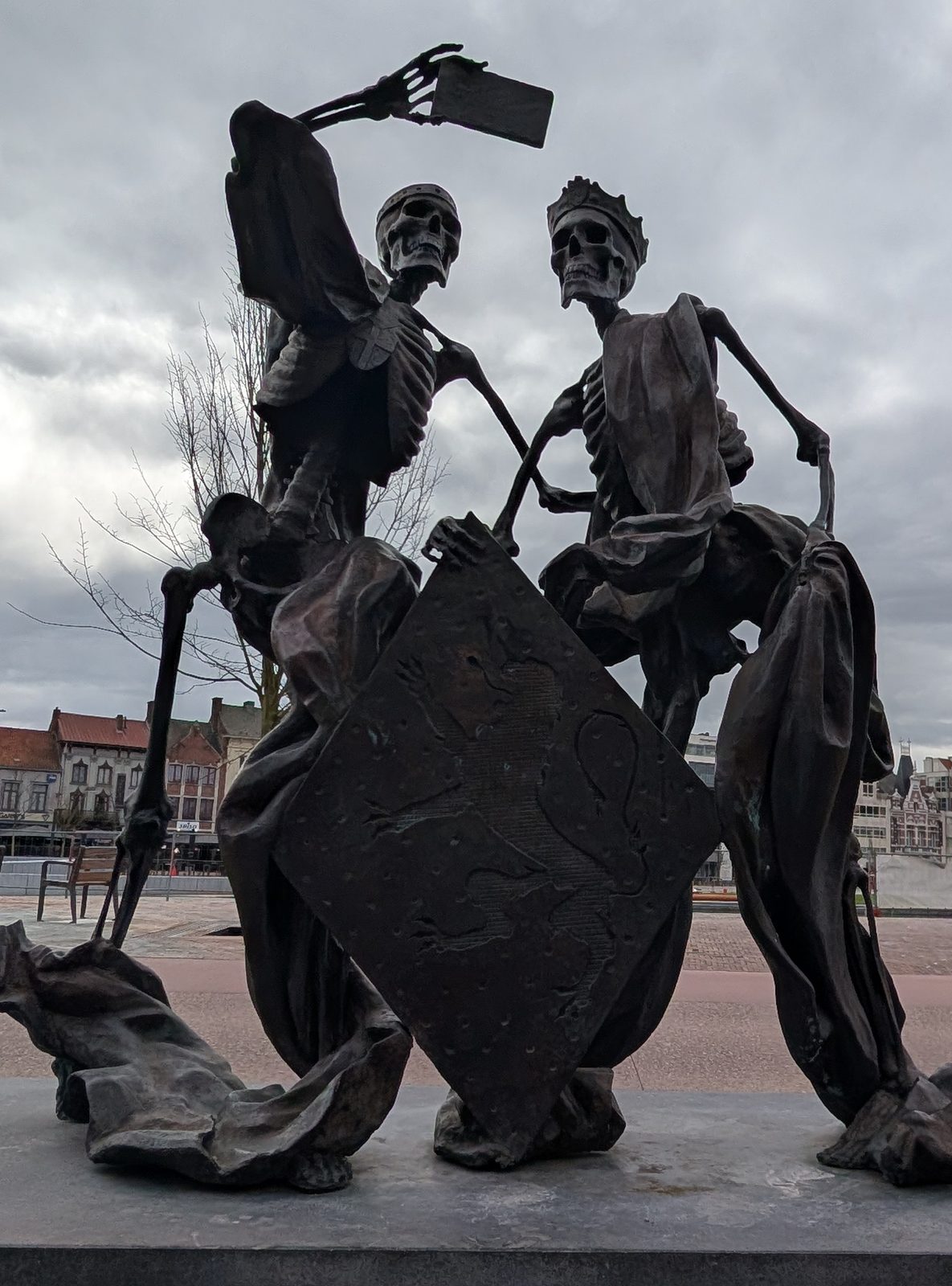
Broekburg relief account, ADN Lille, Chambres des Comptes B 421, per Donche, Vlaamse Stam 2006; 1324 chancery act per Rogghé, Appeltjes van het Meetjesland 9, 1958; the countesses' patronage of Oosteeklo in Gallia Christiana, Tomus V, 1731.
Suster Clara van Vlaendren (attested 1423, † 1448) — The prioress who signed her own name.
Head of the convent ter Anghelendale near Bruges. In a 1423 charter she wrote of herself, in plain Flemish: "Wy Suster Clara van Vlaendren" — the earliest bearer we know who used the name of herself, in her own document.
Vredius, Probationes, 1643, p. 268.
Isabelle van Vlaenderen (15th c.) — The chronicler's ancestress.
Victor's daughter, married into the de Wijndt family of Oostburg. A century later her descendant Nicolaes Despars wrote the great Cronijcke of Flanders — by his own account, the chronicler of the counts was writing the story of his own grandmother's grandfathers.
Despars, Cronijcke van den lande ende graefscepe van Vlaenderen, De Jonghe ed. 1840. The Despars compendium →
Joanna van Vlaenderen fa Jooris (Eeklo, 1700) — The farmer's daughter.
On 8 January 1700 she and her husband sold their small farmstead in Eeklo, and the register wrote her the old way: "Joanna van Vlaenderen fa Jooris" — daughter of Jooris. Her father worked the same parcels a generation earlier. No titles, no crusades: a documented father-to-daughter link among the ordinary families who actually carried the name through the centuries.
De Smet, "Het historisch kadaster van Eeklo," Appeltjes van het Meetjesland 58, 2007.
The abbey's own list of abbesses records Elisabeth "de Flandre," first abbess of Oosteeklo, who died in 1230 — some seventy-five years before the earliest bearer we can document. Was she comital kin? We looked. No surviving document says so, and so this project does not say so either. She stays on this page as a question, not an ancestor — that is the standard everything else here is held to.
Series Abbatissarum in Gallia Christiana, Tomus V, Paris 1731, cols. 227–228.
Lives in the record
Meester Joos van Vlaenderen (Oudenaarde, 1626–1637) — The lawyer.
A university-trained "Meester" whose four children were baptized at Sint-Walburga in Oudenaarde, godparents drawn from the professional families of the town. Proof the name carried on in the educated middle ranks of Flanders long after the noble line ended.
Sint-Walburga baptism registers, Rijksarchief AGATHA inv. 517.
Carolus van Vlaenderen & Clara de Vos (Nokere, 1634) — The jurist and the accused.
When Clara de Vos was tried for witchcraft before the leenhof of Nokere in 1634 and condemned to death, a jurist of the name gave a formal legal opinion in the case; the Carolus van Vlaenderen who matriculated at Leuven in 1620 is the most plausible candidate. Not every bearer wore the name in comfortable circumstances, and this page owes the record its darker entries — so it remembers Clara de Vos, too.
Leenhof consultation, Baronnie van Nokere, 24 November 1634, Kasteel van Nokere, Fonds Casier; contents confirmed by Prof. Jos Monballyu. KU Leuven matriculation register, 1620.
Into the modern age
Eduardus & Frans Eduard Van Vlaenderen (19th–20th c.) — The millers.
Bought the Vinderhoute windmill in 1886; when the 1905 storm flattened it, the family built the stone mill that still bears the name today.
Inventaris Onroerend Erfgoed object 33582. The Mill →
Petrus Van Vlaenderen (Waarschoot, 1893) — The chapel builder.
A workman of Waarschoot — the American line's home parish — on whose initiative the chapel of the Voorde was completed in 1893, "as a stone set into the wall testifies." The stone, and the name on it, still stand.
Martens, "Hemel en aarde bewegen," Appeltjes van het Meetjesland 62, 2011.
Charles Louis Van Vlaenderen (1854–1913) — The emigrant.
Born in Bassevelde, sailed from Antwerp to New York in 1875, settled in Fort Wayne and later Kentucky. Every American Van Flandern descends from him — including the line whose Y-DNA anchors this project.
Bassevelde geboorteakte no. 52; Allen County naturalization declaration, 1880.
Isidoor Van Vlaenderen (1873–1917) — The executed.
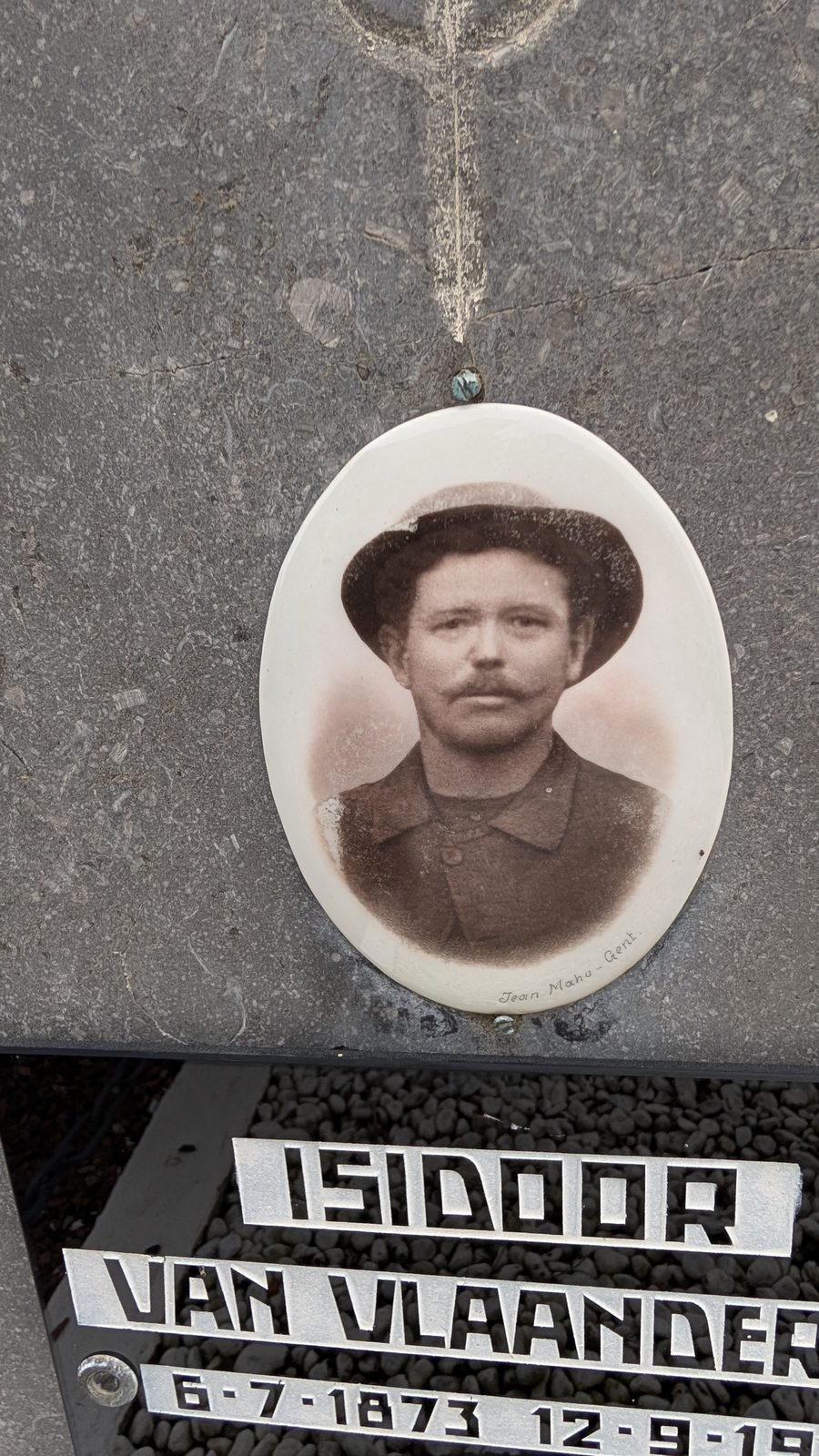
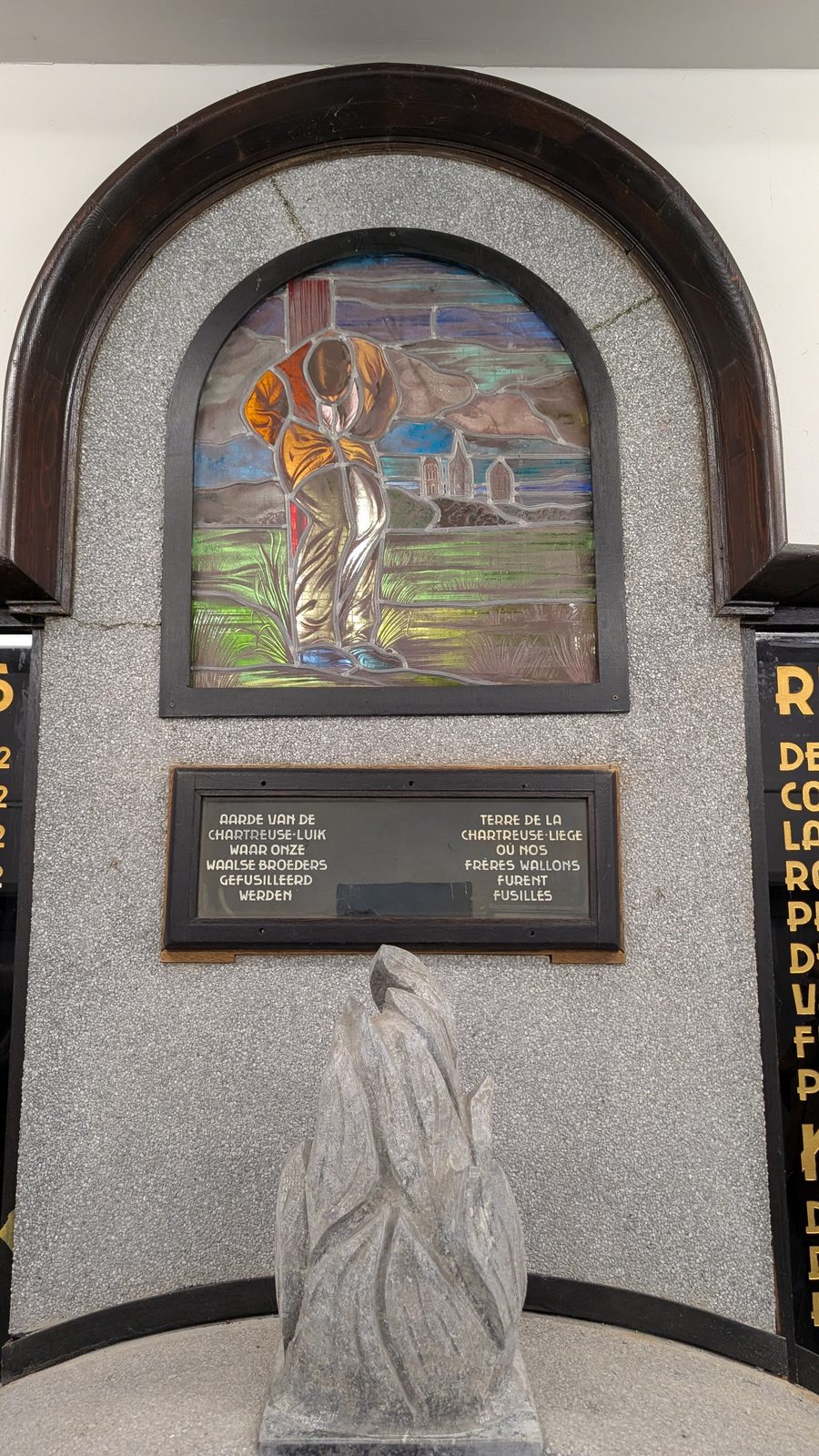
Born at Boekhoute in 1873, a game warden in the border country, husband of Elodie De Zutter and father of a large young family. He carried messages for British intelligence across the Dutch border; arrested early in 1917, he was shot by the German occupier at the Oord der Gefusilleerden in Gent on 12 September 1917, alongside two women of the same network, Leonie Rammeloo and Emilie Schatteman of Boekhoute. He could not write; his farewell letter was set down for him. He is remembered in two places: on his grave at Boekhoute, where a ceramic portrait sits above his name, and at the Oord der Gefusilleerden in Gent, as one stone among the fifty-two and on the honor board inside.
Boekhoute churchyard and Oord der Gefusilleerden, Gent, field documentation 2026; execution and network context per Cuppens 2017, martinusevers.org, and the VDKG memorial site.
Alfons Van Vlaenderen (1906–1940) — The soldier of May 1940.
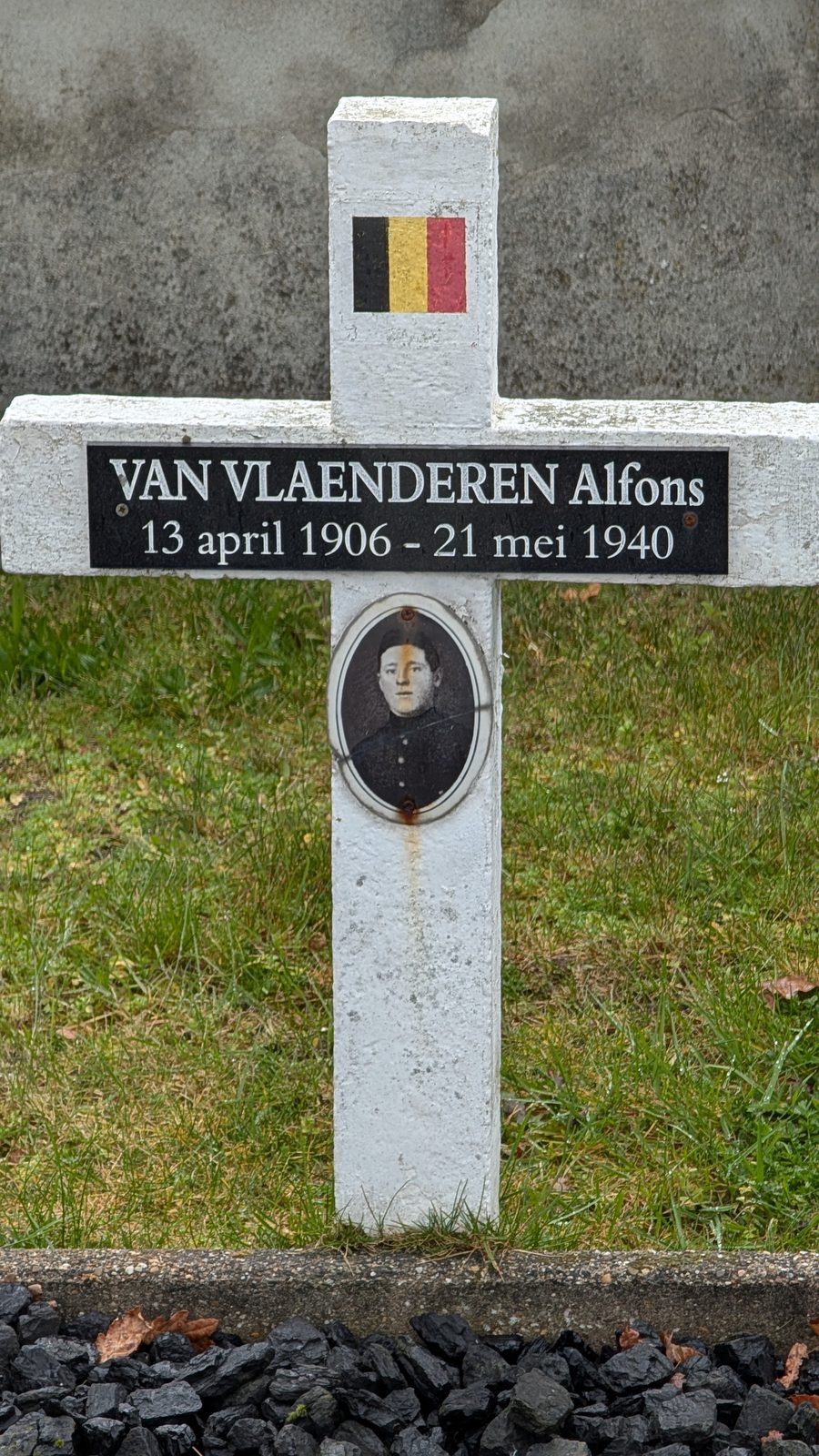
Fell on 21 May 1940 in the Battle of the Lys, in Belgium's eighteen-day defence against the German invasion. He lies at Eeklo with his portrait on the stone — a different Eeklo family from Isidoor's: two lines of the name, two wars, two markers a few kilometres apart.
Eeklo gemeentelijke begraafplaats, field documentation 2026.