Medieval & Collateral Lines
A surname documented among the acknowledged natural children of the Flemish comital house — hereditary in several of their lines from the late fourteenth century onward — with the house-name in use among legitimate cadet branches from 1275.
The earliest documented patterns of use of van Vlaenderen as a hereditary surname are not toponymic — that is, not simply a ‘from Flanders’ label of geographic origin. They cluster within the historic County of Flanders, inside the comital network. The house-name appears among legitimate Dampierre cadet branches from 1275, and comital natural children (bastards, in the language of the period's own records) are attested bearing it from 1304–1305; in the lines descending from Louis de Male's natural sons it is documented as a hereditary surname across successive generations. Whether these earlier and later usages reflect one continuous naming convention is a working hypothesis still under test. Female bearers appear as well, their lines ending with them. What unites the documented cases, on the project's reading, is an inherited identity marking comital blood, used as a personal surname when no specific seigniorial title carried more weight.
The largest documented cluster of bearers is the bastard cohort of Louis II de Male (1330–1384), the last Count of Flanders of the House of Dampierre. De Lichtervelde's 1935 census documents at least eighteen of Louis's natural children. Five of his direct natural sons founded surname-bearing lines, and a substantial number of his daughters carried the name in marriages out of the comital house. This page traces the five bastard lines, the broader cadet-branch context, and the descendants who carried the surname forward.
Research Overview
Encountered without context, van Vlaenderen appears to mean simply “from Flanders” — a merely toponymic name (one built from a place-name), like van Gent or van Brugge. The documentary record tells a more specific story. Within the comital house of Flanders, van Vlaenderen / de Flandres worked as a dynastic marker — a heritable house-name carried by acknowledged natural children, on the model of the French royal house, whose acknowledged natural children bore the branch name — de France, de Valois, de Bourbon — as a mark of descent (Anselme, Histoire généalogique de la maison royale de France). It is toponymic in form — built from a region-name — but its referent (what the name points to) was the house, not a place of origin. The clearest, best-documented expression of the pattern is the bastard cohort of Louis II de Male, set out below; the project's working hypothesis is that the convention reaches back earlier in the same dynasty, though those earlier attributions are debated and offered as hypotheses under test.
The function intensifies sharply under Louis de Male, whose substantial bastard cohort produces most of the documentary record we have. After 1384, the Dampierre comital title was extinguished — it passed out of the family to Burgundy through Margaret of Male — while the bastard descendants carried the surname forward. The 1522 epitaph of Joncheer Antheunis van Vlaenderen, gheseyt van Praet (Gailliard p. 260) shows a Praet-line individual still carrying both names a century and a half later. But the convention itself appears to predate the de Male cohort, and the families carrying it cluster inside the historic County rather than appearing as migrants from its borders. The argument is laid out below.
Five Lines, Three ClustersStrongly Corroborated
Five of Louis de Male's natural sons founded surname-bearing lines: Lodewijk de Haze (Wessegem and Elverdinghe-Vlamertinghe, killed at Nicopolis 1396, line ending in the second generation), Victor (Wessegem and Ursel after 1398), Lodewijk de Fries (Praet and Woestine), Jan sans Terre (Drincham), and Robrecht (Elverdinghe and Vlamertinghe after 1396). All five used van Vlaenderen — and the variants van Vlaendren, de Flandre, de Flandres — as a hereditary surname. Four of the five lines carry forward beyond the second generation, and the surname surfaces in later records as three geographic clusters: the Meetjesland and Ghent hinterland (Victor's line, with the Praet line also seated at Aalter), French Flanders around Cassel (the Drincham line), and Brabant near Brussels (the Praet line through its Brabantine marriages). Robrecht's line, traced through Caspar and Karel to Karel's daughter (c. 1491–1505), is documented but extinguished and does not appear as a later cluster; Lodewijk de Haze's line ended in the second generation.
Beyond Louis de Male, the same hereditary pattern appears to reach earlier in the dynasty — a working hypothesis still under test, not a settled claim. Guy van Vlaenderen lord of Richebourg appears in the 1331 banneret list of Flanders, with his line traceable to 1503; his exact parentage within the comital house is debated [6]. A generation earlier still, Jan van Vlaenderen is named in 1304–1305 peace negotiations as paternal half-brother of Count Robrecht III de Béthune — a natural son of Guy de Dampierre — and Robrecht III's own natural daughter Elisabeth (also Isabella) van Lierde is acknowledged in a 1324 dowry act as vrouwe van Zomergem, though styled van Lierde, not van Vlaenderen. The house-name also recurs across legitimate Dampierre cadet branches: the lords of Cassel from 1275, of Dendermonde from 1313, the counts of Namur from 1331. If these earlier attestations hold, the same heritable house-name runs across several generations and multiple descent lines within one comital house — the pattern a dynastic referent predicts and a place-of-origin label does not.
A toponymic surname typically scatters. People leave places; the name follows the migrant outward, thinning as it spreads. Van Gent, van Brugge, van Kortrijk — these names turn up across Flanders and beyond, carried by people who left. Van Vlaenderen does something different. Its historic bearers concentrate, across centuries, inside the County itself — clustering in the inland Meetjesland, in the Cassel region of French Flanders, and in the Ypres quarter where Robrecht's line is documented before its extinction. That stable, multi-generational clustering is what continuous patrilineal descent would produce — but clustering alone cannot prove it. Record survival, duplication in the compiled trees, and independent formation of the same name could each contribute to the pattern. The clustering tells us where to look; documentary and Y-DNA evidence must make the connection — the pairing that grounds the published methodology of surname-genetic research [5]. It is not the diffusion pattern of a place-of-origin label.
Even on the narrower medieval reading of Vlaenderen as the coastal strip, the paradox holds: the record shows inland concentration, not coastal dispersal. Toponyms mark where people came from. What the documentary and geographic record of van Vlaenderen describes is something else — a name that marks who people were.
Five Van Vlaenderen Progenitors, 18 Children
Research overview diagram — text summary
This diagram shows the five surname-bearing bastard lines descending from Louis II de Male, Count of Flanders (1330–1384), the last count of the House of Dampierre. Loys "le Hase" line: The earliest-endowed direct bastard, granted the consolidated lordships of Wessegem, Ursel, and Oostburg in 1372; later holdings include the twin lordship of Elverdinghe and Vlamertinghe, the fiefs of Schuurveld and Vake, and the captaincy of Biervliet. Six dated chronicle attestations in Despars's Vol. III span 1380–1396; killed at Nicopolis 25 September 1396 alongside half-brothers Louis Friese and Jan sans terre. Four documented natural children — Hector, Regnault, Kathelijne, Joanna — but no continuing line beyond the second generation. Victor's line: Lord of Ursel and Wessegem in the Meetjesland; last attested in his 1430 testament, his lordships reverting to the comital domain in 1431 — the year taken as his working death date. Three documented natural sons — Lodewyc, Janne, and Adam — named in primary charters 1427–1447. Le Frison-Praet line: Lord of Praet and Woestine; killed at Nicopolis 1396. Six attested generations through Lodewijk IV (d. 1556) and Jan zonder generatie (d. 1545); cadet branches include the Josse de Flandre line and the Onlede younger-sons branch. Drincham line: Granted Drincham castle near Cassel in 1383; killed at Nicopolis 1396. Documented across five generations in French Flanders. Robrecht's line: Lord of Elverdinghe and Vlamertinghe just outside Ypres; Viscount of Ypres jure uxoris through his 1419 marriage to Anastasie d'Oultre. Died 21 January 1434. Three documented natural sons — Jean de Flandres (legitimized 1448), Caspar (active 1453–1464 as bailiff of Elverdinghe-Vlamertinghe and then of Ypres), and Karel van Vlaenderen (d. 1491; the Langemark epitaph names him filius M'her Robrecht). Karel's daughter, married to Omarus de Crane and buried at Langemark, is the last documented bearer of the line.
The five direct bastards above founded the principal surname-bearing lines. They are not the whole cohort — De Lichtervelde's 1935 survey cross-references Louis de Male's 1384 testament, Vredius, the Despars compendium, and the Burgundian inventory at Lille to document at least eighteen natural children. The remaining thirteen (right) include line-ends, single-generation attestations, and daughters whose surname passed into other families through marriage rather than descending as a patrilineal line. Click to open.
Research Branches
Victor van Vlaenderen
Natural son of Louis de Male. Lord of Ursel and Wessegem in the Meetjesland. Three natural sons documented across three primary charters (1427, 1441, 1446). His son Adam, last attested in Ghent on 18 March 1447, is the closest documented individual bridge candidate to the modern East Flanders clusters.
Louis Friese van Vlaenderen
Natural son of Louis de Male. Lord of Praet and Woestine. Killed at Nicopolis 1396. Founded the House of Flanders-Praet — six attested generations using van Vlaenderen as a hereditary surname. The Praet patrimony acquired the Vrijhof at Aalter by 1516, anchoring this branch in the Meetjesland alongside Victor's; cadet continuations remain under research.
Jan "sans terre" van Vlaenderen
Natural son of Louis de Male. Granted Drincham castle near Cassel, 1383. Killed at Nicopolis 1396. Four documented generations in French Flanders through the 1470s — the leading candidate for the founding of the Volckerinckhove/French Flanders cluster.
Loys "le Hase" van Vlaenderen
Natural son of Louis de Male and the earliest-endowed of his nine documented bastard sons. Granted the consolidated lordships of Wessegem, Ursel, and Oostburg in 1372 (forfeited Gerard de Moor lands), and subsequently the twin lordship of Elverdinghe and Vlamertinghe, the fiefs of Schuurveld and Vake, and the captaincy of Biervliet; six dated chronicle attestations in Despars's Vol. III span 1380–1396. Killed at Nicopolis 25 September 1396 alongside half-brothers Louis Friese and Jan sans terre. Four documented natural children — Hector, Regnault, Kathelijne, Joanna — but no continuing line beyond the second generation; the Wessegem and Ursel seigniories regranted to Victor in 1398, the Elverdinghe-Vlamertinghe lordships to Robrecht.
Robrecht van Vlaenderen
Natural son of Louis de Male. Lord of Elverdinghe and Vlamertinghe just outside Ypres; Viscount of Ypres jure uxoris through his 1419 marriage to Anastasie d'Oultre. Died 21 January 1434. Three documented natural sons — Jean (legitimized 1448), Caspar (active 1453–1464), and Karel II (d. 1491) — carried the surname through the second half of the fifteenth century in the Ypres quarter. Karel's daughter, married to Omarus de Crane and buried beside her father at Langemark, is the last documented bearer of the line.
Reference
The Documentary Gap, 1447–1580
The span of more than 130 years between the last confirmed comital-line bearer and the first Meetjesland parish generation. Evidence in hand, searches completed, active archival targets, and four working hypotheses for how the gap closes.
Methodology & Sources
How archival documents are transcribed and translated, and the curated reading list of primary and secondary works that underpin the research.
Sources & Scholarship
Primary sources, archival finding aids, and scholarly literature cited in the dossiers — the evidentiary basis of the project in one place.
Where the surname clustered over time
Across three time windows, the recorded bearers of Van Vlaenderen concentrate in a handful of clusters inside the historic County — early on in French Flanders, then the Meetjesland and Ghent, with a later offshoot in Brabant — rather than scattering as a place-of-origin name would. Use the buttons to move between periods.
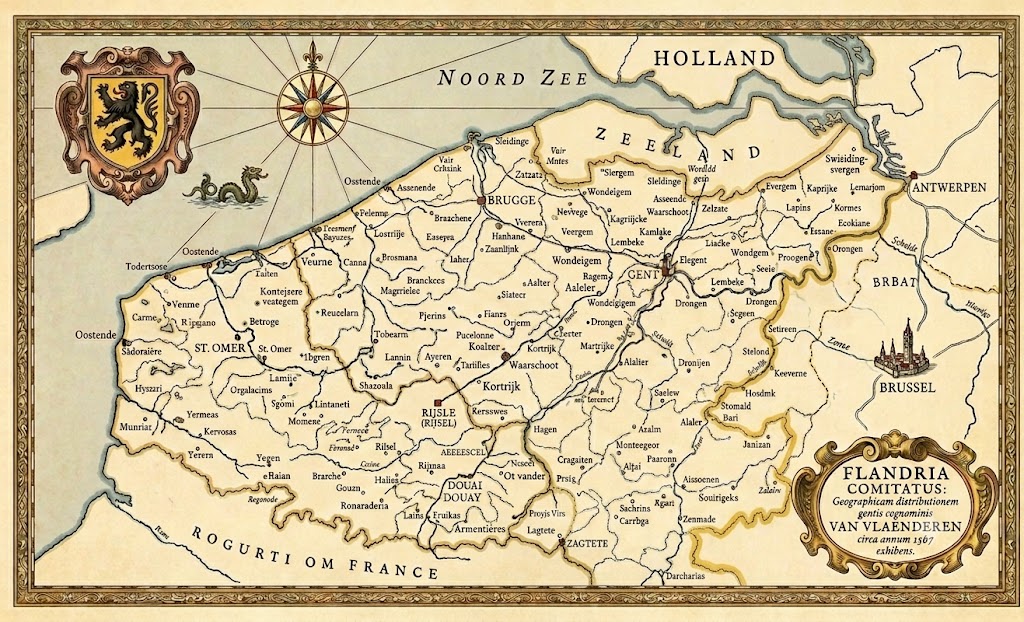

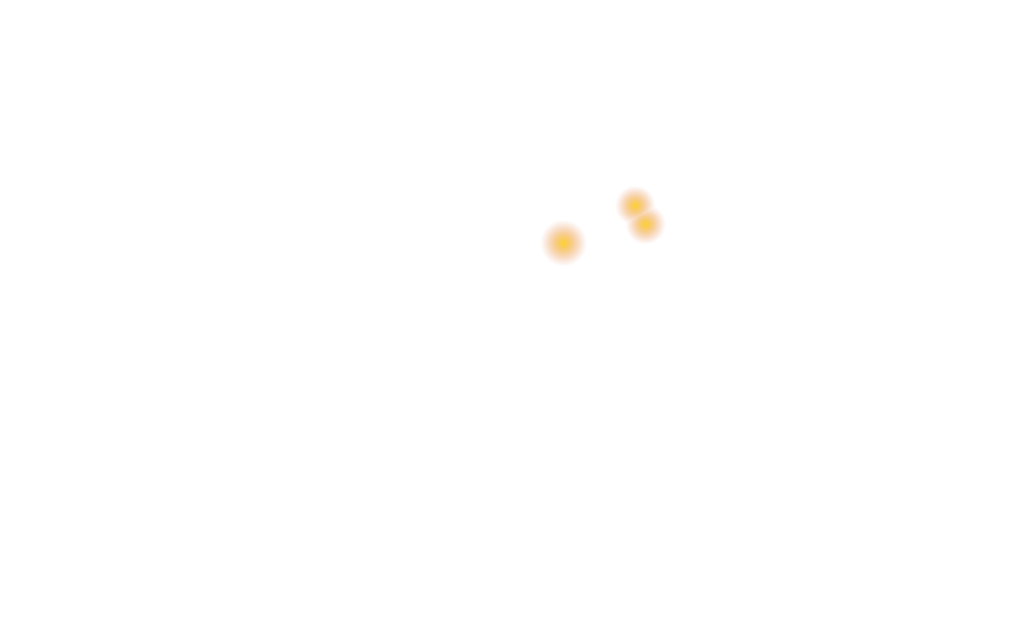
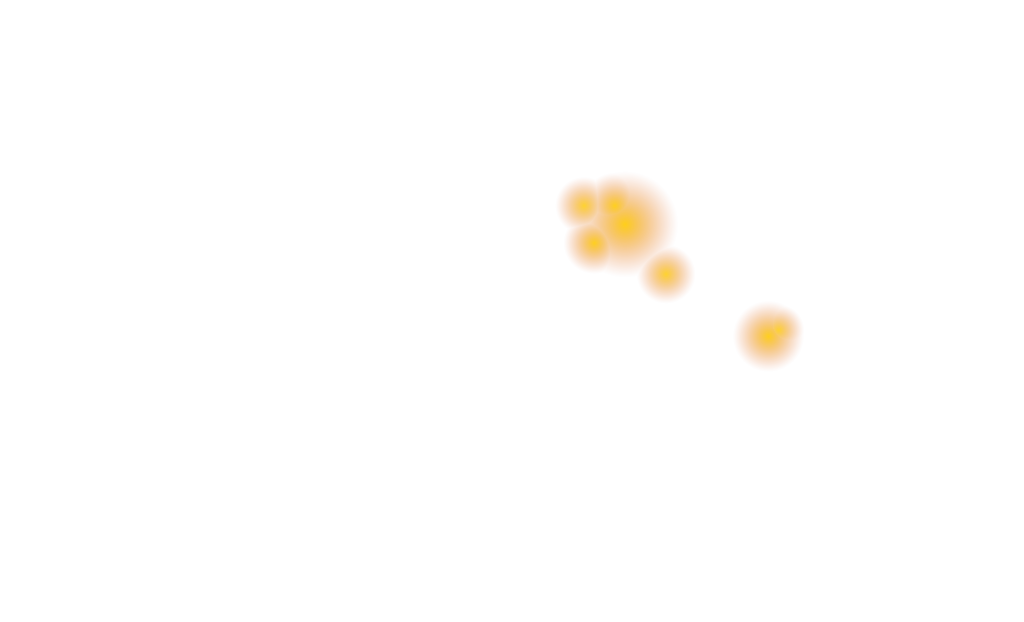
Surname locations and per-municipality counts from Geneanet (records to c. 1600): van VLAENDEREN on Geneanet. The Van Vlaenderen project's own database adds more comprehensive medieval and parish records but remains thin for the tumultuous 1500s — which is why the 16th-century view here is sparse. The antique base map and the density rendering are original.
A fuller database-driven map of the documented parish-register bearers is in progress and will appear in a future release.
Archival Dossiers
For researchers seeking the underlying documentary evidence, we maintain detailed archival dossiers with full charter transcriptions, epitaph data, and source analysis.
Victor van Vlaenderen Dossier
Three-charter nucleus (1427, 1441, 1446), Victor's 1430 testament, Lodewyc's descendants, and the Oostborch epitaph evidence.
Louis Friese: Archival Dossier
Primary source extracts and territorial history of the House of Flanders-Praet.
House of Praet: Lineage Dossier
Six generations with primary-source confirmed data. Johan I's five children, Lodewijk II's six children (including the Josse de Flandre cadet branch), and the 1517 Knesselare charter.
Jan sans terre — Drincham Dossier
The 1383 Drincham land grant, four documented generations in the Cassel area, the Veurne epitaph of Jacques de Drincham, and the geographic-documentary case for the French Flanders Van Vlaenderen cluster.
Research Articles
Analytical and contextual writing that sits alongside the archival evidence — distributional analysis, historical interpretation, and speculative threads with clearly marked evidentiary status.
Four Functions, Three Clusters
A primary source and distributional analysis of the Van Vlaenderen surname across four documentary functions and three geographic clusters spanning three centuries. Tests the toponymic and bastard-line hypotheses against Geneanet heat-map data and the onomastic record.
Seals, Lions, and the Politics of a Surname
How twelfth-century Flemish noble seal culture — the lion, the Dover Recognitio, and the political weight of territorial identity — provides historical depth for the Van Vlaenderen hypothesis. Based on Nieus (2021).
Notes and Sources
The research overview on this page rests on primary-source attestation of the five documented bastard lines, on the distributional evidence set out in the Four Functions article, and on supporting scholarship in Flemish seal culture and medieval genealogy. Full documentation is maintained on the linked dossier and article pages.
[1] Primary-source attestation for the five bastard lines (Victor, Jan sans terre, Louis Friese, Robrecht, and Loys le Hase) and the broader cohort: Olivarius Vredius (Olivier de Wrée), Genealogia Comitum Flandriae, Bruges 1642–43, Tabula XVI: Nothi Ludovici Maleani Comitis Flandriae, fol. 275–297. Read in full at Sterling Library, Yale, May 2026. The Tabula identifies eleven of Louis de Male's natural children plus the Gosnay establishment cohort, with the Gaillard MS rendering of two primary witnesses for Karel van Vlaenderen — the Langemark epitaph of Karel himself and the adjacent epitaph of his wife Catharine de Verdeghem.
[2] The primary modern critical works on Louis de Male's bastard cohort are P. de Lichtervelde, “Les Bâtards de Louis de Male,” Handelingen van het Genootschap voor Geschiedenis 78(1-2) (1935), pp. 48–58, DOI 10.21825/gvg.92141, which provides the fullest cohort census (18-minimum, framed as a floor) with archival citations to Brussels A.G.R., Lille A.D.N., and Dijon Côte d'Or; and Buylaert, Repertorium van de Vlaamse adel (ca. 1350 – ca. 1500), Ghent: Academia Press, 2011, Van Vlaanderen entries pp. 736–759, which cites primary archival folios (ARA Rekenkamer, SAG Reeks 301/330, RAB blauwe nummers, KBR Fonds Merghelynck, SAB politieke oorkonden) for nearly every claim. Together these are the load-bearing modern scholarship for the lineages traced here. The Foundation for Medieval Genealogy (MedLands), v5.0 January 2025, is a useful tertiary-source finding aid synthesizing similar material with primary-source footnotes.
[3] The distributional analysis across three surname clusters (c. 1500, 1600, 1700) and the toponymic-paradox argument are set out in full in the Four Functions, Three Clusters article. Read the Four Functions analysis →
[4] Jean-François Nieus, "Aristocratic seal ownership in twelfth-century Flanders: A world in between" (preprint, Academia.edu, 2021; University of Namur; forthcoming in peer-reviewed publication). Provides historical depth for how Flemish elite identity and territorial names functioned in the comital network. Discussed in full on the Seals, Lions, and the Politics of a Surname page. Read the Seals article →
[5] The methodological framework for using surname-geographic distributions as indicators of patrilineal Y-chromosomal lineage is set out in King, T.E. & Jobling, M.A. (2009), "What's in a name? Y chromosomes, surnames and the genetic genealogy revolution," Trends in Genetics 25(8): 351–360, and applied in the Belgian/Flemish-population context in Larmuseau et al. (2013), already cited on the DNA page.
[6] Guy van Vlaenderen lord of Richebourg is named in the 1331 banneret list of Flanders (F. Buylaert, Repertorium van de Vlaamse adel, Ghent: Academia Press, 2011, p. 738, citing M. Vandermaesen, “Le droit de livrée à la cour de Louis, comte de Flandre, en 1331,” in Secretum Scriptorum: Liber Alumnorum Walter Prevenier, Leuven: Garant, 1999, pp. 279–306). His parentage is unsettled: Vandermaesen and Vredius (Genealogia Comitum Flandriae, Tabula XVI) group him among the natural sons of “Louis de Nevers / de Crécy,” while Despars's Cronijcke (De Jonghe ed., Vol. II) makes him a bastard of Robert of Cassel (d. 1331). A man of banneret rank in 1331 cannot be a son of Louis I de Nevers de Crécy (b. c. 1304, d. 1346), so the chronology points to Robert III de Béthune's generation — the conflict reflects the long-standing ambiguity between the two men called “Louis of Nevers.” The line continues to Guy II and his daughter Margriete (leenhoudster at the Gentse Oudburg, 1503; Buylaert p. 739).
Ongoing Work
The documentary evidence above establishes that acknowledged natural children of the Counts of Flanders used de Flandre / van Vlaenderen, and that in several lines descending from Louis de Male the name passed as a hereditary surname from the late fourteenth century into the sixteenth. The house-name also recurs among legitimate cadet branches from 1275 and among earlier comital natural sons from 1304; whether those usages represent the same naming convention as the later hereditary lines remains under analysis. No documentary connection has yet been established between these medieval lines and the later parish-register families — whether the modern Van Vlaenderen clusters of the Meetjesland, French Flanders, and Brabant descend from them is the distinct question the Y-DNA project is designed to answer.
Research priorities centre on bridging the documented medieval bearers to the first parish-register Van Vlaenderens in the Meetjesland (c. 1568) and the French Flanders cluster around Volckerinckhove. Several lines remain open as candidate bridges: Victor's line ends at Adam in Ghent in 1447; the Praet-line cadet branches — including the Josse (Joos) van Vlaenderen collateral line, documented to the death of its last male, Lodewijk V, on 31 October 1591, and the Onlede younger-sons branch — extend well into the early-modern era; and the Drincham line is traceable in French Flanders through the 1470s. The April 2026 identification of a 1610 Belhoute schepenbank record naming Jan van Vlaenderen and his son Aert Janse adds a closer bridge point on the early-modern side of the gap. Active archival targets include the Ghent Staten van Goed series (Ambacht Assenede I & II), the Landboek and Leenhof records covering the Meetjesland, and the Cassel castellany administrative record series at the Archives Départementales du Nord in Lille.