Four Functions, Three Clusters
A primary source and distributional analysis of the Van Vlaenderen surname: what the phrase was doing in medieval documents, where surname-bearing families actually lived, and what that tells us about the name's origin.
Research Article
The Analytical Challenge
The surname Van Vlaenderen presents a problem that genealogical research alone cannot resolve. The name means, literally, from Flanders — which makes it superficially indistinguishable from the hundreds of Flemish toponymic surnames that attached themselves to migrants as geographic labels. On that reading, tracking the surname's origin is not a genealogical question but a linguistic one, and every family bearing the name simply descends from someone who, at some point, moved away from Flanders into a community where their origin needed a label.
This project does not accept that reading as sufficient. The documentary and distributional evidence raises questions that pure toponymy does not answer. This article sets out what that evidence is, what it supports, and what it leaves unresolved.
The Four Functions of the Phrase
Before any surname-bearing individual can be identified in a historical source, the phrase van Vlaenderen must be correctly interpreted. In the Flemish documentary record, it performs at least four distinct functions, and conflating them produces false evidence in either direction. The full framework is presented on The Name page; the summary below provides the necessary context for this analysis.
The Distribution Data
Geneanet's surname frequency data, drawn from user-contributed genealogical records, provides a broad distributional picture of where and when the surname Van Vlaenderen appears in the record by century. [¹]
The Geneanet data does not measure how many people bore the name in a given century — it measures how many recorded individuals appear in user-contributed databases. Record survival varies enormously by region and period.
In Belgium, systematic parish registration only became widespread following the Council of Trent's mandate (1545–63), with implementation in rural Flemish parishes often lagging into the 1570s–80s. The wars of the Spanish Netherlands — the Spanish Fury (1576), the fall of Ghent (1584) — further thinned surviving registers. Belgian Van Vlaenderen families alive and reproducing in the early sixteenth century are, in many cases, simply invisible: the registers that would document them no longer exist.
In French Flanders, the Ordinance of Villers-Cotterêts (1539) mandated civil registration earlier than the Tridentine reforms reached the southern Netherlands, and the Cassel area had good institutional record infrastructure. The apparent dominance of Volckerinckhove in the 1500 data therefore reflects, at least in part, that it is the best-documented cluster at that point, not necessarily the oldest or largest. Where the Belgian data appears thin before 1600, the probable explanation is record loss, not a late founding event.
A further complication applies specifically to lines touching nobility. Where a surname-bearing family connects to a documented comital line — as all the Van Vlaenderen bastard branches do — Geneanet entries multiply sharply through repeated copying of the same individuals across user-contributed trees. A figure like 551 entries attributed to Volckerinckhove before 1500 almost certainly represents a much smaller number of real historical individuals, replicated many times. The raw counts should be treated as clustering signals, not population estimates.
c. 1500
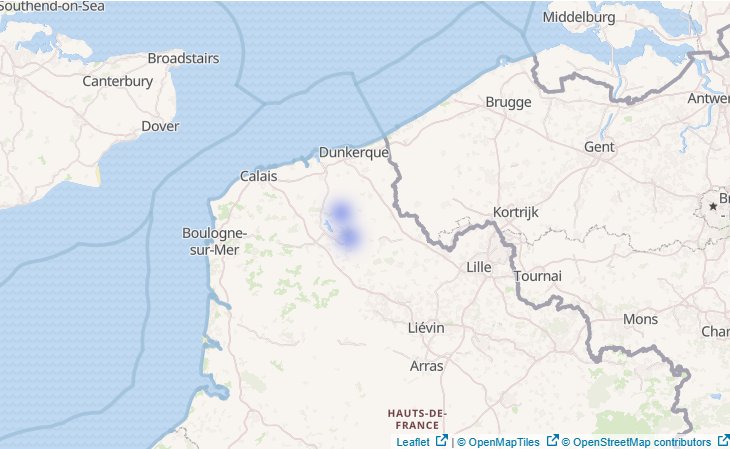
| Municipality | Region | Count |
|---|---|---|
| Volckerinckhove | Nord, France | 551 |
| Renescure | Nord, France | 34 |
| Aalter | Belgium | 11 |
| Bollezeele | Nord, France | 5 |
| Waarschoot | Belgium | 5 |
c. 1600
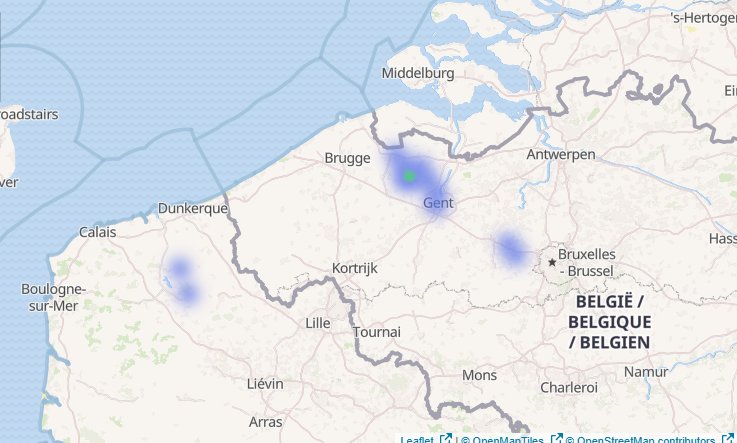
| Municipality | Region | Count |
|---|---|---|
| Volckerinckhove | Nord, France | 539 |
| Sleidinge | Belgium | 273 |
| Oostwinkel | Belgium | 158 |
| Wambeek | Belgium | 39 |
| Renescure | Nord, France | 32 |
| Waarschoot | Belgium | 30 |
| Gent | Belgium | 22 |
| Evergem | Belgium | 22 |
c. 1700
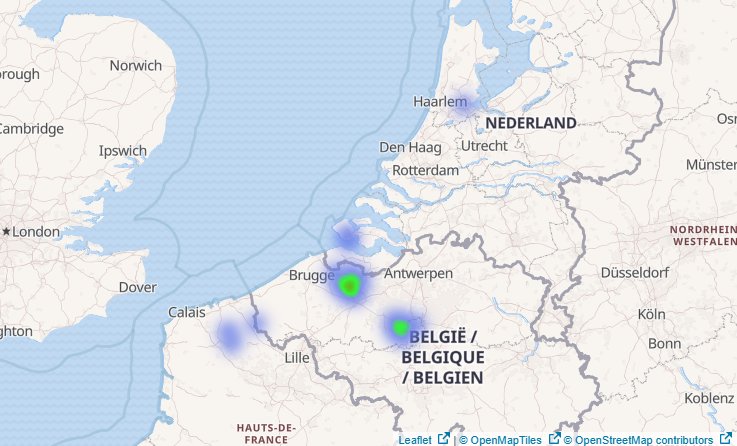
| Municipality | Region | Count |
|---|---|---|
| Sleidinge | Belgium | 552 |
| Volckerinckhove | Nord, France | 523 |
| Oostwinkel | Belgium | 346 |
| Evergem | Belgium | 150 |
| Ertvelde | Belgium | 121 |
| Gent | Belgium | 85 |
| Ursel | Belgium | 53 |
| Bassevelde | Belgium | 48 |
Four observations follow from this data, accounting for the record-survival caveat.
The French Flanders cluster sits exactly where a bastard line was settled. Geneanet consistently places the early Van Vlaenderen entries in the Volckerinckhove/Cassel zone — the area where Jan "sans terre" van Vlaenderen, a natural son of Louis de Male, was granted the lordship of Drincham in 1383, and where his descendants are documented through the 1470s. The local count is inflated by noble-tree duplication (per the caveat above); what matters is the geography, examined under the Volckerinckhove Question below.
The Belgian cluster is large but its apparent sixteenth-century founding is partly a record artifact. Sleidinge, Oostwinkel, and Evergem collectively hold over 500 recorded individuals by 1700. The cluster's near-invisibility in 1500 reflects the near-absence of Flemish parish records before c. 1570. On this reading the founding event would belong to the mid-fifteenth century rather than the mid-sixteenth — a hypothesis consistent with the record-loss pattern, not yet a demonstrated event.
A third, smaller cluster appears near Brussels by 1600. Wambeek, in Flemish Brabant, emerges with 39 individuals and is consistent with a founding event in the mid-to-late sixteenth century with a geographic connection to Brabant.
A Zeeland cluster becomes visible by 1700. The 1700 heat map shows a concentration in Zeeuws-Vlaanderen/coastal Zeeland. This is geographically consistent with Lodewijc van Vlaenderen's burial at Oostburg (before 1482). However, a complete sweep of Gysseling and Debrabandere's index of personal names in the Vier Ambachten (KCTD 71, 1999) — roughly 3,000 attestations behind some 1,000 individuals, overwhelmingly the schepenen and schouten of the 14th and 15th centuries — yielded zero Bucket 4 hits for the surname. Van Vlaenderen does not appear as a hereditary surname bearer in the region's medieval record. This argues strongly against an indigenous Zeeuws-Vlaanderen formation — zero hits in a corpus of this size and coverage is significant, though absence from one index cannot be exhaustive proof — and points to the surname arriving into Bassevelde/Assenede from elsewhere, most likely the Ghent hinterland, consistent with the 1568 Franciscus attestation.
The Progenitor Candidates
The following tables set out the documented individuals who carried the Van Vlaenderen surname before the distributional clusters are established, together with their descendants in the surname-carrying line. All documentary evidence derives from a direct reading of Olivarius Vredius (Genealogia Comitum Flandriae, Pars Secunda, Tabula XVI, fol. 275–288, Bruges 1642–43). [²]
Tier 1 — Natural sons of Louis II de Male
| Name | Territory | Known descendants (surname-carrying) | Attested dates | Most plausible founding region |
|---|---|---|---|---|
| Victor van Vlaenderen | Ursel & Wessegem, Meetjesland. Lord from 1399; reverted to crown 1431. | Three natural sons: Lodewyc, Janne, Adam (attested 1427–1447). See Tier 2. | 1399–1430 | Progenitor line — founding role exercised through sons |
| Loys 'le Frison' van Vlaenderen | Woestijne & Praet, Franc de Bruges. Granted 25 Dec 1373. Killed at Nicopolis 1396. | Son Jan Heer van Praet; six-generation titled line to Jan van Onlede (d. 1523). See Tier 2. | 1373–1396 | Progenitor line — founding role exercised through son Jan |
| Jan 'sans terre' van Vlaenderen | Drincham castle, near Cassel, French Flanders. Granted 22 Nov 1383. Killed at Nicopolis 1396. | Son Jan Heer van Drincham; four documented generations to c. 1473. See Tier 2. | 1383–1396 | Progenitor line — founding role exercised through son Jan |
| Loys 'le Hase' van Vlaenderen | Wessegem, Ursel & Oostburg — the forfeited Gerard de Moor lands, granted 9 April 1372; later also Elverdinghe-Vlamertinghe, Schuurveld, Le Vake, and the captaincy of Biervliet. Killed at Nicopolis 1396. | Four natural children: Hector (Bortsant), Regnault (Le Vake), Kathelijne and Joanna (joint Oostkerke house and Le Heneede fief). No continuing line documented past their generation. | 1372–1396 | Eliminated on current evidence — the children's fiefs are not traced past their generation |
| Robert [Roeland] van Vlaenderen | Elverdinghe & Vlamertinghe; Burgrave of Ypres. | No legitimate issue — De Wrée records death sans generation (21 Jan 1434), and Anastasie's epitaph reads ex Roberto verò nullos. Three natural sons are documented or argued: Jean (legitimized 1448 — Directly Attested), Caspar (brothers hypothesis — descent undocumented), Karel (Langemark epitaph filius M'her Robrecht — Strongly Corroborated). See the Robrecht line. | 1420–1434 | Ypres quarter — the natural-son line ends with Karel's daughter (de Crane marriage); no surname continuation |
| Karel van Vlaenderen, Lord of Grutersale | Grutersale; buried Langemark near Ypres, d. 15 Sep 1491. | One unnamed daughter (→ de Crane family; possibly the Marguerite married to Georges Belle, 1460). No sons. The epitaph filius M'her Robrecht places him as Robrecht's son — Strongly Corroborated; see the Robrecht line. Distinct from the senior Karel of Despars's cohort list (position 8), Victor's 1430 testament executor. | 1430–1491 | West Flanders coastal — daughter's line lost the surname |
Tier 2 — Documented descendants carrying the surname
| Name and parentage | Territory / location | Known descendants | Attested dates | Most plausible founding region |
|---|---|---|---|---|
| Adam van Vlaenderen natural son of Victor; by Gertrud Lindekens | Ghent / Meetjesland area. Transfers annuity in Ghent 1446/47. No fixed lordship. | None documented. No wife named. | 1427–1447 N.S. | Meetjesland / Ghent — closest documented individual bridge candidate for the Belgian cluster, alongside the parallel Praet-at-Aalter possibility. Geographically closest to Sleidinge and Oostwinkel. Last attested 1447, three to four undocumented generations before Franciscus (1568). Record scarcity in the intervening period is the expected explanation for the gap, not a late founding event. See also: Victor Archival Dossier → |
| Janne van Vlaenderen natural son of Victor; by Alyssen van Boyeghem | Unknown — no lordship or location documented. | None documented. | 1427–1442 N.S. | Unknown region — cannot be excluded but provides no evidence to work with. |
| Lodewijc van Vlaenderen natural son of Victor; by Alyssen van Boyeghem | Oostburg, Zeeuws-Vlaanderen. Buried in choir of Oostburg church with wife Jacqueline de Wilde (d. Apr 1482). | Joos van Vlaenderen (died young, buried Oostburg — cannot be the Joos in the 1547 Brugse Vrije probate). Daughter Margareta (→ de Baenst; → van Schouteeten — surname lost). Documented male line ends. | 1427–1482 | Zeeuws-Vlaanderen / Zeeland. Documented male line ends at Oostburg. A systematic onomastic sweep of 3,000+ Zeeuws-Vlaanderen records (Gysseling, Vier Ambachten, c.1240–1500) yielded zero Bucket 4 hits — the surname is not indigenous to this region. An undocumented further child of Lodewijc could still anchor the Zeeland thread, but the bridge would not have been local. |
| Jan van Vlaenderen son of Loys le Frison; Heer van Praet en de Woestijne | Praet & Woestijne, Franc de Bruges. Active 1431–1439 in Ghent Keure records. | Lodewijc Heer van Praet (d. 1488) + daughters. Six-generation titled line. Lodewijc's epitaph is at Aalter. | 1431–1442 | Franc de Bruges / Aalter (Meetjesland) / Brabant. The Praet patrimony acquired the Vrijhof at Aalter by 1516, anchoring the senior line in the Meetjesland through to c. 1590. Lodewijc Heer van Praet's epitaph is at Aalter — which appears in the 1500 distribution data with 11 individuals. Later marriages into Gruithuyse and Bourgogne families are also consistent with a Wambeek/Brussels footprint. |
| Jan van Vlaenderen son of Jan sans terre; Heer van Drincham | Drincham, near Cassel, French Flanders. | Jan (Gen 3), Philippe (d. unmarried), Jacques (d. Veurne 1459), Loys, Francq. Four documented generations. | c. 1400–c. 1430 | French Flanders — plausible contributor to the Volckerinckhove cluster. Geography and chronology are consistent. Whether the Drincham line alone accounts for the cluster's scale, or an earlier Function 3 founding event is also required, remains an open question. |
| Lodewijc van Vlaenderen Heer van Praet grandson of Loys le Frison; epitaph at Aalter, d. 1488 | Praet, Woestijne, Bevere, Ommele. | Loys, Jan (→ Jan van Onlede d. 1523), Jacques, Josse, Loyse, Jehenne de Flandre. | c. 1440–1488 | Aalter (Meetjesland) and Brabant / Brussels cluster (Wambeek). His son Lodewijk IV's 1516 marriage to Jossine van Praet anchored the senior line at the Aalter Vrijhof through to c. 1590. Marriages into Gruithuyse and Bourgogne families also draw descendants toward Brabant. Son Loys was Grand Bailiff of Ghent from 1515. |
Testing the Bastard-Line Hypothesis
The hypothesis is that the documented surname clusters each descend from one or more of the natural sons of Louis de Male who carried the Van Vlaenderen name as a hereditary identifier. Once the record-survival caveat is applied, the distributional evidence provides stronger support than a raw reading of the data suggests.
The Belgian cluster (Sleidinge, Oostwinkel, Evergem, Bassevelde) is geographically consistent with descent from Victor's son Adam. Adam was last attested in Ghent in 1447. The cluster's epicentre lies immediately north of Ghent, within easy distance of Ursel and Wessegem where Victor held his lordship. The cluster's near-invisibility before 1600 is most plausibly explained by record scarcity: the registers that would document Adam's grandchildren simply do not survive. On this reading, the founding event belongs in the mid-fifteenth century, and the Belgian cluster is not appreciably younger than the French Flanders one. This hypothesis is plausible and merits continued archival investigation; it is not yet proven. The 150-year documentary gap between Adam's last attestation (1447) and the first Belgian parish records is discussed in the Victor Archival Dossier.
The Brabant/Brussels cluster (Wambeek) is consistent with descent through the Praet line, whose later documented members married into Brabantine noble families. This is a probable connection but has not been verified through direct archival evidence.
The French Flanders cluster (Volckerinckhove) is most plausibly the documented Drincham bastard line persisting in its founding geography — the geographic-documentary coincidence set out under the Volckerinckhove Question below. Whether a second, independent Function 3 founding event also contributed remains a secondary hypothesis requiring direct archival verification.
The Zeeland cluster (visible by 1700) most likely falls outside the bastard-line story altogether. It is geographically suggestive of Lodewijc van Vlaenderen's Oostburg line (Tier 2 above), but that line's documented male descent ends at Oostburg, and the medieval onomastic silence already noted (zero hereditary bearers in the Vier Ambachten index) shows the surname was not indigenous to the region. The most visible transport mechanism is the post-1585 Calvinist exodus, when Flemish Protestants fleeing the Habsburg reconquest moved north into Holland and Zeeland. But that tells us how the name arrived, not how it originated: by 1585 the surname was already hereditary, so a refugee "van Vlaenderen" might be a commoner carrying a long-settled toponymic name, a fresh "from Flanders" label, or a descendant of one of the count's natural sons who fled north with the dynastic surname. The name alone cannot separate these. One documented candidate for that third possibility is Philips van Vlaenderen, a non-inheriting younger son of the Praet cadet branch, named in a 1547–48 legal matter in Holland and Zeeland and then dropped by the genealogical authorities that trace only the title-bearing line. Whether any line of his survived in the north is exactly the kind of question the surname cannot settle and only Y-DNA could. Given how thin the surviving late-sixteenth-century record is, Y-DNA is the most promising route to an answer — though a documentary link, if one surfaced, would bear on it too.
Testing the Pure Toponymy Hypothesis
Pure toponymy is not wrong everywhere: for a lone emigrant — a Fleming who settled in England, Germany, or France and was labelled by his origin — "from Flanders" is the natural reading, and this analysis does not dispute it. What that reading cannot explain is the clustered, internally-Flemish distribution the data actually shows. As a universal account it fails on three grounds, none affected by the record-survival caveat:
Geography is internally contradictory. The Meetjesland and French Flanders clusters are both inside the historic County of Flanders. Sleidinge, Oostwinkel, Waarschoot, and Volckerinckhove are not places where a family would be identified as "from Flanders" by their neighbours — they are Flanders. A purely toponymic label attaches to people who have moved away from the place the name describes. The heaviest concentration of Van Vlaenderen surname-bearers is precisely where the label is geographically meaningless. This argument is independent of record survival: it applies equally whether the data shows 11 Belgian individuals in 1500 or 500.
The concentration is wrong for a generic label. Purely toponymic surnames typically scatter and thin as geographic memory fades. What the data shows instead is extreme and durable concentration — a cluster fixed on one village across two centuries (the raw figure of 551 entries by 1500 is a copying artifact, per the caveat above, but the clustering it signals is real); explosive growth in a bounded region in East Flanders. These are the patterns of founded lines, not diffuse geographic labels.
The Zeeland cluster complicates it further. If Van Vlaenderen simply meant "from Flanders" as a migration label, it would be expected in Zeeland — where Flemish migrants genuinely would have been identified by their origin. Yet the Zeeland cluster appears late (visible by 1700) and small, rather than being the earliest and most natural concentration. This is consistent with the name originating as something other than a migration label.
The Eeklo Vlaminc family is the methodological control case. A purely toponymic Flanders-related surname does emerge in the Meetjesland documentary record — but it is the Vlaminc / De Vlaming family of Eeklo (attested 1335–1585), not a Van Vlaenderen line. De Vlaming is the Middle Dutch ethnic designator meaning "the Fleming," applied where Fleming-ness is socially salient — which inside Flanders is the comparatively rare situation of a burgher whose family came to a Flemish town from elsewhere. Van Vlaenderen, by contrast, is a herkomstnaam applied at distance to someone who has moved away from the county; it is semantically inert inside Flanders and would not naturally adhere to a resident family. The Eeklo Vlamincs followed the expected pattern. The Meetjesland Van Vlaenderens did not — strengthening the case that the East Flanders Van Vlaenderen cluster cannot be explained by either a generic toponymic mechanism or by the parallel ethnic-designator mechanism that the same geography demonstrably did support.
In principle the toponymic reading still fits an isolated outlier — a Fleming who emigrated and was labelled abroad. But the medieval record gives it no footprint: Debrabandere's earliest attestations all sit inside Flanders, in the interior comital circuit, not out where a "from Flanders" label would do real work. A genuinely toponymic, exterior coining does appear — but only with the post-1585 Calvinist exodus into Holland and Zeeland, three centuries after the comital cohort. That silence outside Flanders is itself evidence: the toponymic reading survives as a logical possibility for individual outliers, yet the record shows it operating only late and at the edge — never as an account of the medieval clusters.
How the Cohort Used the Name: Register-Dependent NamingStrongly Corroborated
The distribution data tells us where the surname persisted. The documentary record adds a second, independent line of evidence: how the comital-bastard cohort actually used the name. For the cohort, "van Vlaenderen" was not a fixed, invariant surname but a functionally deployed identifier. Three name-layers coexisted for the same individuals — the dynastic house-name (van Vlaenderen / de Flandre), a lordship-title (van Praet, van Drincham, van Voorhoute), and a personal byname (die Hase, le Frison, sans terre) — and the genre and purpose of the record determined which combination surfaced. A register-tagged pass over the project's collected attestations — roughly 95–105 genuine cohort name-attestations across some 35–40 bearers and ten distinct register types, from treaty charters and Latin annals to testaments, tombs, armorials, fief registers, and fiscal rolls — supports two register-robust observations and one directional one. [⁴]
First, the house-name travels bound to the bastard-marker and comital descent, in every register. The 1385 Peace of Tournai charter carries "Lodewijc gheseyt die hase, bastaert van Vlaendren" in its Dutch recension (Excellente Cronike van Vlaenderen, Vorsterman 1531, folio lxxvi) and "Loys, bastard de Flandre, dict le Haze" in its French recension (de Smet, Recueil des chroniques de Flandre, Tome IV, p. 311) — the same man, the same act, the dynastic formula stable across languages. The Latin annals render the same figure "Ludovico, bastardo Flandriae" (de Budt, in de Smet, Tome I). A place-of-origin label does not behave this way: no scribe writes "the bastard of Bruges, called Jan."
Second, the house-name is interchanged with a lordship-title for the same person. Robrecht is "de Flandre, viconte d'Ypres" in one register and "van Vlaendren, heere van Elverdinghe" in his brother Victor's 1430 testament; the Praet heirs appear as "heer van Praet" in chronicle narrative, "van Vlaenderen gheseit van Praet" in the fief registers, and "van Vlaenderen, heere van Praet" on their tombs. One identity, two surfaces — the behaviour of a lineage name layered over a territorial title, which an origin-name does not show. The recurring bridged form "van Vlaenderen gheseyt van [lordship]" is discussed as a methodological principle on the Methodology page.
Third — and directionally, not absolutely — formal documents foreground the house-name. Treaty charters, testaments, tombs, and armorials carry the dynastic form at roughly 80% of attestations. The effect is a tendency, not a rule, and the counter-instances are carried openly: Despars's narrative chronicle uses the full "bastaert van Vlaenderen, ghezeyt [byname]" formula as its default, while the 1459 Veurne tomb of Jacob van Drincham carries the lordship name alone — where the same family's 1466 Houtem tomb reads "Mer Jans van Vlandres gheseit Drincham" (Donche 2006). The lordship-only instances cluster precisely where a lordship had hardened into a heritable surname of its own.
One refinement matters for reading any single attestation. Recognized nobles of the cohort appear in fiscal and wardship registers under the bare house-name with an honorific — "mher Victoors van Vlaenderen" in the 1431 Aardenburg accounts and the 1441 Cadzand deed, and the entire Honnelede wardship series of 1545–49 (RAB, Brugse Vrije, Staten van Goed, TBO 184). The isolated bare-form attestations recorded in the surname dictionaries — a Jacop van Vlaendre in a 1376 bailiff's account, a Jaquemaerde van Vlaendren in the 1426 Kortrijk orphan-court records (Debrabandere, WFB2) — sit in exactly the register types that produce bare forms for nobles and commoners alike. A bare fiscal "van Vlaenderen" therefore does not by itself settle a bearer's status in either direction. The reading rule this project applies: weight the register, and look for the binding-and-interchange signature — not the bare surface form alone.
What the Corpus Excludes: Half-Vlaenderen and Other Separate Name-FamiliesStrongly Corroborated
The argument above does not claim that every Vlaenderen-derived name is dynastic. The opposite: there are genuinely ordinary, toponymic name-families built on Vlaenderen, and the project keeps them out of its corpus. Demonstrating that the classification is discriminating, not totalising, is part of the method.
The clearest case is "Half-Vlaenderen" / "Alfvlandren" — a separate name-family, not a van Vlaenderen variant and not a bastardy marker. Its etymology, per Debrabandere (Persoonsnamen in Hulster Ambacht 1300–1400, 2018, §233), reads half as "in the middle of": "Naam voor iemand die uit Midden-Vlaanderen stamt" — a name for someone from central Flanders — with the direct parallels of German Halbendorf and French Demiville. Beele's onomastic study of the Ypres accounts files it as its own lemma (nr. 940), cross-referenced away from the van Vlaanderen lemma (nr. 2866). [⁵] Its three known medieval attestations are all ordinary burgher and tenant contexts: Oostburg 1281 (Clais, son of Willelmus Alfvlandren, and Willelmus's widow), Ypres 1306 (Willaumes Halfvlaendren), and Hulst 1372 (Pieter van Alf Vlaenderen). On this basis the 1306 Ypres bearer is excluded from the project's hereditary-bearer roster.
The same discipline applies to the -man formation Vlaender(t)man (attested 1399 at Eeklo; De Flou, Woordenboek der Toponymie van Westelijk Vlaanderen), treated as a separate ordinary name-family rather than folded into the cohort. Together with the Eeklo Vlaminc control case above, these exclusions define the boundary of the claim: the dynastic reading is argued for the documented comital cohort and its surname-carrying descendants — not for every name in the record that contains Vlaenderen.
The Volckerinckhove Question
The French Flanders cluster can look like an anomaly: 551 Geneanet entries before 1500 seem far too many for a single bastard line. But that figure is a noble-tree artifact (see the caveat above) — a small number of real individuals copied many times across user-contributed trees. Set the count aside, and the picture is simple.
The earliest recurring documentary association of the hereditary surname in French Flanders falls in the Cassel/Drincham zone — exactly where Jan "sans terre" van Vlaenderen, a natural son of Louis de Male, was granted land by charter in 1383 and where his descendants are attested through the 1470s. That documentary-geographic coincidence, not the count, is the argument: Jan's descendants seeded the French Flanders surname population, which the Geneanet data then echoes — multiply and noisily — across three centuries.
A secondary hypothesis — that a Function 3 origin (comital court staff hardening into a hereditary surname at Cassel) also contributed independently of the Drincham line — remains possible. The key archival test is date: any Van Vlaenderen in Cassel administrative records before 1383 would establish an independent pre-bastard origin; anything after 1383 is more likely a branch of or continuation from the documented line.
This project is seeking collaborators with access to the Cassel castellany administrative record series. The specific research question is whether any individual named Van Vlaenderen (or de Flandre / de Flandres) appears in those records before 1383 — the date of Jan "sans terre"'s documented land grant.
The relevant archive is the Archives Départementales du Nord (Lille), which holds the Cassel castellany records and related comital administrative series. A pre-1383 identification would establish an independent Function 3 origin for the French Flanders cluster; a post-1383 identification would more likely represent a continuation of the bastard line.
Get in Touch →Conclusions and Open Questions
The surname Van Vlaenderen cannot be adequately explained by a single mechanism. The distributional and documentary evidence together support a model of multiple documented bastard-line foundations: Victor's branch in the Meetjesland, Jan sans terre's Drincham branch in French Flanders, and the Praet line's later Brabantine trajectory. Pure toponymy is inadequate as a complete explanation and is effectively falsified as a universal account of the name's distribution. The key insight is that the Geneanet distribution evidence is most useful as a geographic clustering signal — pointing to where surname-bearing families persisted — rather than as a demographic count.
The strongest specific conclusions the evidence currently supports: the Belgian cluster is most plausibly founded through Victor's son Adam van Vlaenderen, with the documentary gap explained by record loss rather than a late founding event. The Brabant/Brussels cluster is most plausibly connected to the later Praet line. The French Flanders cluster is most plausibly the Drincham bastard line persisting in its founding geography, with the geographic-documentary coincidence — not the count — as the substantive argument. The Zeeland cluster, visible by 1700, is best explained as non-indigenous — the medieval onomastic silence weighs heavily against a local formation — arriving from elsewhere, most visibly with the post-1585 Calvinist exodus into Holland and Zeeland and by migration into the Zeeuws-Vlaanderen border from the Ghent hinterland. Whether any of those bearers descend from a comital line or carry the name as an ordinary toponym, the name alone cannot say; with the late-sixteenth-century record so thin, Y-DNA is the most promising way to find out.
Three specific research priorities follow. First, the archival gap between Adam's last attestation (1447) and Franciscus in Ghent (1568): the Staten van Goed series at RAG (Ambacht Assenede I & II) and the Landboek/Leenhof records are the primary remaining bridge candidates — Gysseling did not index these, and they have not yet been searched. Second, the Cassel castellany records at the Archives Départementales du Nord for any Van Vlaenderen before 1383 — which would establish whether an independent Function 3 origin preceded the bastard-line settlement at Drincham. Third, Y-DNA comparison between the Belgian and Dutch Van Vlaenderen lines, which would provide a direct test of whether any Zeeland thread shares a common male-line ancestor with the Meetjesland families.
Notes and Sources
[1] Geneanet surname frequency data for Van Vlaenderen, accessed April 2026. en.geneanet.org/surnames/van%20VLAENDEREN. Figures represent individuals in user-contributed genealogical records attributed to the relevant municipality and century. Record coverage varies significantly by region and period; see the methodological caveat above.
[2] Olivarius Vredius (Olivier de Wrée), Genealogia Comitum Flandriae a Balduino Ferreo usque ad Philippum IV. Hisp. Regem, Pars Secunda: Continens Probationes XII posteriorum tabularum, Bruges: J.B. & Lucas Kerchovios, 1642–43. Tabula XVI, fol. 275–288 (PDF pp. 285–298). Direct reading conducted April 2026. The primary charter data for Victor's three sons derives from the Acta Curiae partitionum Gandensium, as transcribed by Vredius from the Ghent partition court registers.
[3] Foundation for Medieval Genealogy, MedLands: Flanders, Hainaut, v5.0, updated January 2025. Tertiary compilation consulted as a pointer to primary sources during the survey phase; not used as a fact-level authority. fmg.ac/Projects/MedLands/FLANDERS.htm
[4] Principal register-attestation sources: Excellente Cronike van Vlaenderen (Antwerp: Willem Vorsterman, 1531), folio lxxvi; J.-J. de Smet (ed.), Recueil des chroniques de Flandre / Corpus Chronicorum Flandriae, 4 vols. (Brussels: Hayez, 1837–1865), Tome I and Tome IV p. 311; N. Despars, Cronijcke van den lande ende graefscepe van Vlaenderen, ed. J. De Jonghe, 4 vols. (Bruges, 1840–1842); P. Donche, "De Familie Van Drincham, gezegd van Vlaanderen (ca. 1350 tot 16de eeuw)," Vlaamse Stam 42/6 (2006), pp. 548–580; K. De Flou, Woordenboek der Toponymie van Westelijk Vlaanderen (Bruges, 1914–1938); Rijksarchief Brugge, Brugse Vrije, Staten van Goed, Eerste Reeks, TBO 184, nrs. 21300–21302; F. Debrabandere, Woordenboek van de familienamen in België en Noord-Frankrijk (WFB2, 2003).
[5] F. Debrabandere, Persoonsnamen in Hulster Ambacht 1300–1400 (2018), §233, citing Haeseryn 1953, p. 67 for the 1281 Oostburg attestations; W. Beele, Studie van de Ieperse persoonsnamen uit de stads- en baljuwsrekeningen 1250–1400, 2 vols. (Handzame: Familia et Patria, 1975), Glossarium lemmas 940 (halfvlaanderen) and 2866 (Vlaanderen, van).